
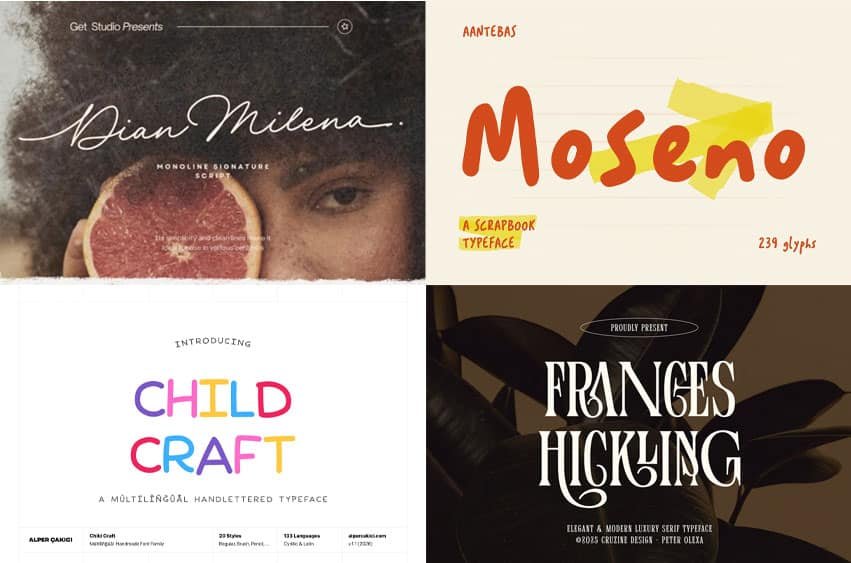
If you sell custom signs, invitations, mugs, or printables, your font choice *is* your product. Not a supporting element — the actual thing the customer is paying for. Which makes it strange how many shops run the same four free scripts every other shop is running.
The peak seasons for this work in the US are brutal and predictable: wedding invitation orders cluster December through March for spring and summer dates, and the holiday personalization rush starts in October. If you’re refreshing your type library, do it in the quiet months, not in November.
Four picks from Envato Elements and Creative Fabrica covering the four jobs this category actually has.
1. Dian Milena Font— the wedding workhorse
Dian Milena – Signature Script
Signature-style scripts are the backbone of the wedding category, and this one has the casual-but-expensive quality that works on a save-the-date without tipping into formal calligraphy.
Use it for: the couple’s names on an invitation suite, welcome signs, place cards.
Pair it with: a plain serif for the details. Date, time, venue, and RSVP copy should never be in script — your guests need to read an address, not admire it.
Test it on real names before you list. Script fonts break down on specific letter pairs. Type out “Jennifer,” “Ryan,” “Zoe,” anything with a double-L or a capital followed by a descender. That’s where the connections either work or visibly don’t.
For Commercial Licence Click Here
Try 4 Handwritten and Script Fonts for Etsy Sellers, Wedding Designers, and Small Shops
Type your own text to see how it looks before you download.
2. Moseno Font — for the scrapbook and planner market
Moseno – Handwritten Scrapbook Font
Scrapbook styling is a whole product category on Etsy and in the planner community, and it’s a different job from wedding script: this needs to look like a real person wrote it quickly, not like a calligrapher labored over it.
Use it for: planner stickers, journaling cards, photo overlays, digital scrapbook kits.
Watch for: consistency. The trick with “handwritten” faces is that real handwriting varies. If a font’s letters are too uniform it reads as a font pretending, which defeats the purpose. Check whether it ships alternates that let you vary repeated letters.
For Commercial Licence Click Here
3. Child Craft Font— a family, which is rare here
Child Craft – Playful Handwritten Font Family
Most handwritten fonts are a single weight. This is a family, and in a category where that’s unusual, it’s genuinely useful — you can build a full printable with a heading, a subhead, and body copy without switching typefaces.
Use it for: nursery prints, classroom decor, teacher-seller shops, kids’ party printables.
Market note: the teacher-seller segment on Etsy and TPT is large, seasonal (back-to-school hits in July and August), and specifically wants friendly-but-legible. Playful faces that sacrifice legibility don’t sell there.
For Commercial Licence Click Here
4. Frances Hickling Font — handwriting, not script
Frances Hickling
Natural handwriting rather than styled script. This is the one for anything that should feel like a note left on a counter — packaging inserts, thank-you cards, the little “handwritten” touch in a shipped order.
Use it for: brand voice moments. The thank-you insert, the care card, the sticker on the tissue paper.
Don’t use it for: the logo. Honest-handwriting faces are deliberately imperfect, and imperfection at wordmark scale reads as sloppy rather than personal.
For Commercial Licence Click Here
The licensing thing every Etsy seller needs to read
This is the part people skip and then panic about, so let me be direct about the distinction that actually matters:
Using a font to make a design you sell is normally fine. Printing “The Hendersons — Est. 2019” in a script font onto a wooden sign and selling the sign is standard commercial use. That’s what a commercial license is for.
Selling the font itself, or something that functions as the font, usually is not. This includes: selling an SVG cut file where the font is the file, bundling the font file into a digital download, or selling an editable Canva template that requires the buyer to have the font installed.
“End product” rules and item count limits are real. Many stock licenses cap how many end products you can produce from a single license, and treat “one design” differently from “one physical product.” A personalized item where every unit has a different name may or may not count as one end product depending on the terms.
I’m not your lawyer, and the Envato Elements and Crreative Fabrica license terms are the authority here — not this post and not a Facebook group. Read the license page for the specific item, and if you’re doing SVG cut files or Canva templates, read it twice. That’s the use case where sellers get caught.
Practical notes for handmade sellers
Look for alternates and ligatures. Good scripts ship with swash alternates specifically so “Anna” doesn’t have two identical A’s sitting next to each other. Accessing them needs software that supports OpenType features — Illustrator, Affinity, or Cricut Design Space to a limited degree.
Know your OTF vs TTF situation. Some alternates only work in OpenType-aware software, and Design Space is limited. Know which format you’re working in before you promise a customer a specific look.
Vinyl and laser have minimum widths. Thin script strokes tear when you weed vinyl and burn through on a laser. Test a physical cut first.
Leave a Reply